Applying for a credit card in South Africa is usually straightforward, but approval depends on more than simply earning a salary. Banks and other credit providers normally want to establish who you are, verify your income, understand your monthly financial commitments, and determine whether you can comfortably afford the proposed credit facility.
The exact requirements vary according to the bank and credit card. A basic card may have a substantially lower income requirement than a premium or rewards card.
This guide explains what you generally need to apply for a credit card in South Africa, what documents you may be asked for, how affordability and credit checks work, and what to do before submitting an application.
Important: Credit-card requirements change between providers and products. Always confirm the current requirements directly with the bank before applying.
What are the credit card application requirements in South Africa?
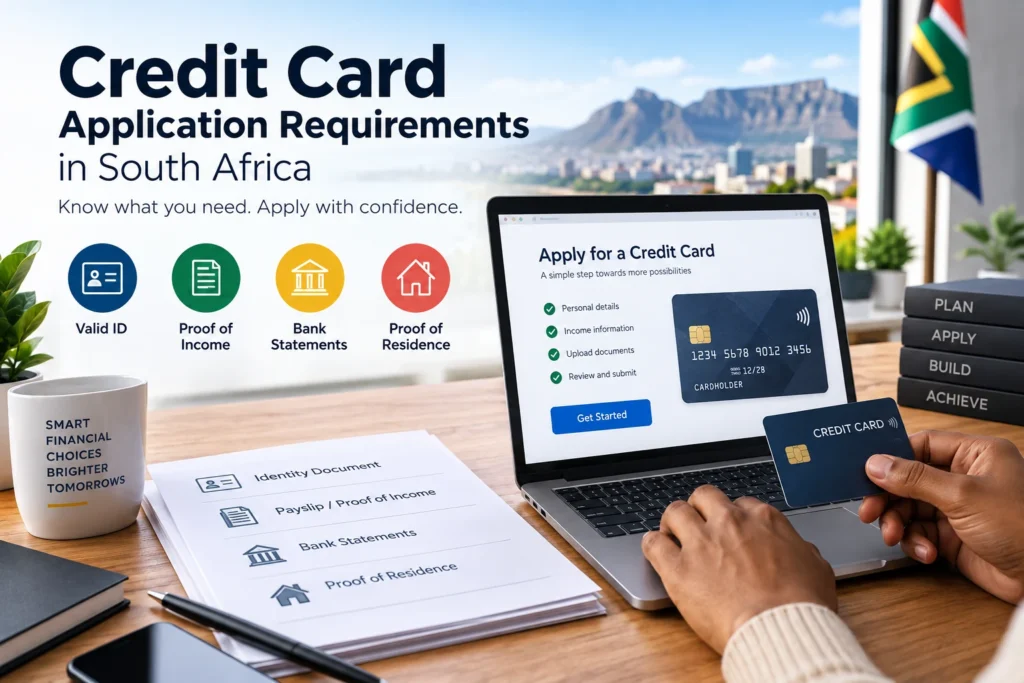
Most applicants should be prepared to provide:
- Proof of identity
- Proof of income
- Recent bank statements
- Proof of residential address
- Employment or income information
- Details of existing debts and monthly expenses
- Consent for credit and verification checks
You will generally also need to meet the card provider’s minimum age, residency and income requirements.
For example, Standard Bank currently requires applicants for its Blue Credit Card to be over 18 and lists a South African ID or passport, recent payslip, three months’ bank statements and proof of residence not older than three months. Its listed minimum income is R5,000 per month.
However, you should not assume that R5,000 is the minimum income for every credit card. Different products have different criteria.
1. Proof of identity
The first requirement is normally a valid identity document.
For South African citizens, this may be a:
- South African ID book
- South African smart ID card
Depending on the provider and your circumstances, a valid passport may also be accepted.
For example, Standard Bank says applicants can provide a South African ID or a passport if they are not South African citizens.
Some providers may apply additional requirements to non-South African residents, such as a valid permit or other residency documentation.
Nedbank’s current Platinum Credit Card requirements, for example, specify a valid South African ID or a valid passport and work permit for eligible applicants.
Why is identification required?
Banks need to verify your identity before providing credit. Identification can also form part of the information required for regulatory and verification purposes.
If the name on your application differs from your identification document, the provider may request supporting documentation explaining the difference.
2. Proof of income
Your income is one of the most important parts of a credit card application.
A provider needs to establish how much money you receive and whether your income is sufficient to support the proposed credit facility.
Depending on your employment situation, proof of income may include:
- Recent payslips
- Bank statements showing salary deposits
- Other acceptable income documentation
- Additional financial records for self-employed applicants
For example, FNB currently lists a recent payslip and three months’ bank statements among the documents needed for its credit cards.
How much must you earn?
There is no single minimum salary that applies to every credit card in South Africa.
The threshold depends on the product.
For example:
| Provider/product | Current listed income requirement |
|---|---|
| Standard Bank Blue | R5,000/month or more |
| Nedbank Gold | R5,000/month |
| Nedbank Platinum | R25,000/month |
| FNB Aspire | R42,000–R450,000/year |
| FNB Premier | R300,000–R749,999/year |
These figures are examples of current product requirements, not a universal industry standard.
Always check the specific product before applying because banks can change eligibility criteria.
3. Three months of bank statements
Three months of bank statements are commonly requested when applying for a credit card.
These statements can help the provider verify your income and understand your financial position.
The NCR’s affordability guidance says credit providers should request either three months’ bank statements or payslips when assessing affordability.
Major banks also list three months of statements in their application requirements.
FNB, for example, currently lists three months’ bank statements among the documents required for its credit cards.
Standard Bank similarly requests three months’ bank statements for its Blue Credit Card.
What should you check before submitting them?
Make sure the statements:
- Are for the correct account
- Cover the requested period
- Clearly show your name
- Show your income deposits where applicable
- Have not been altered
- Are in an acceptable format
If a bank asks for stamped statements, follow its specific instructions.
4. Proof of residential address
Banks may also ask for proof of where you live.
Examples can include:
- Utility bills
- Rental or lease documentation
- Bank statements
- Certain official correspondence
The document may need to be recent.
Standard Bank currently specifies proof of residence not older than three months for its Blue Credit Card.
Absa also lists documents such as utility bills, lease agreements, bank statements from another bank and certain SARS correspondence as examples of documents that can verify residential address, with the document not more than three months old.
The exact acceptable documents vary, so check your provider’s application instructions.
5. You must pass an affordability assessment
Having the required documents does not automatically mean your credit-card application will be approved.
Credit providers must assess whether you can afford the credit.
The NCR explains that affordability assessments consider factors including:
- Gross income
- Statutory deductions
- Minimum living expenses
- Existing debt obligations
- Repayment history
This is important because two people earning the same salary may have very different financial positions.
Example
Imagine two applicants each earn R20,000 per month.
Applicant A has:
- R20,000 income
- R3,000 existing debt repayments
- Relatively low monthly expenses
Applicant B has:
- R20,000 income
- R10,000 existing debt repayments
- Much higher monthly expenses
Their applications could produce different affordability outcomes even though their salaries are identical.
This is why income alone does not guarantee approval.
More Trusted website
- National Credit Regulator — Consumer Rights
- National Credit Regulator — Affordability Assessment Guidance
- TransUnion South Africa — Credit Report & Score
- Standard Bank — Blue Credit Card
- FNB — Credit Cards
- Nedbank — Credit Cards
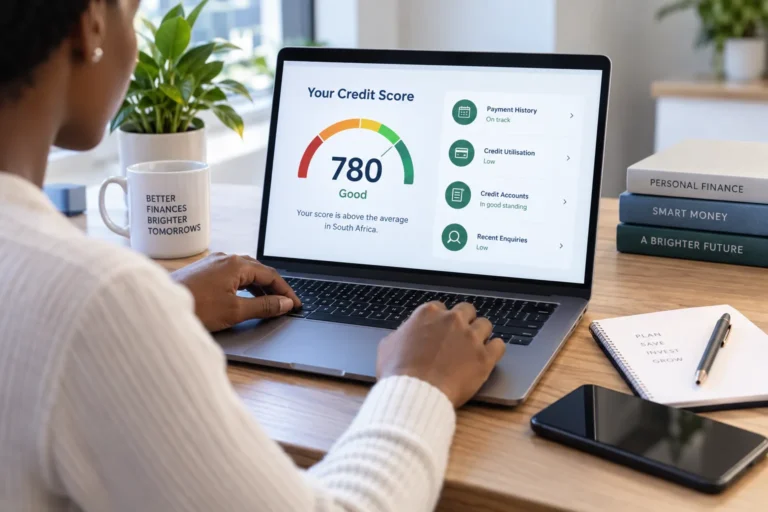
6. Your credit history can affect approval
Credit providers can use information from credit bureaus as part of their assessment.
TransUnion explains that lenders may consider your credit report together with information supplied in the application, affordability calculations and other credit-assessment tools.
Credit information can include factors such as:
- Payment history
- Existing debt
- Defaults or adverse information
- Length of credit history
- Recent credit applications and enquiries
TransUnion says credit information is used by many credit and service providers when building their own credit-risk assessments.
Does TransUnion approve or reject your application?
No.
The credit provider makes the lending decision.
TransUnion specifically states that it does not make the decision to grant or deny credit. Different banks and providers have their own lending criteria.
If your application is declined, the bank or provider is the appropriate party to ask about the reason.
7. Minimum age requirements
Most mainstream credit-card products require applicants to be at least 18 years old.
For example, Standard Bank’s Blue Credit Card requires applicants to be over 18.
Nedbank similarly states that applicants for its Platinum Credit Card must be 18 or older.
However, age is only one part of eligibility.
You may still need to meet income, residency, affordability and credit-assessment requirements.
8. Requirements for self-employed applicants
Being self-employed does not necessarily prevent you from applying for credit.
However, proving income can be different from proving a regular salary.
A provider may request additional evidence to establish your income and financial position.
The NCR’s guidance recognises that self-employed, informally employed and other consumers whose income is not evidenced through conventional payslips or bank statements may require alternative methods of income verification.
Depending on the provider, this could mean providing additional financial information.
If you are self-employed, it is sensible to have the following available:
- Personal bank statements
- Business bank statements where relevant
- Proof of income
- Tax-related documentation where requested
- Financial statements where requested
Do not assume that every bank uses the same documentation requirements.
9. Requirements for non-South African residents
Non-South African residents may be able to apply for certain credit cards, but eligibility can depend on residency and immigration status.
Some providers request:
- Valid passport
- Valid work permit or other appropriate permit
- Proof of South African residence
- Proof of income
- Bank statements
For example, Nedbank’s current Platinum Credit Card information refers to a valid passport and work permit for non-citizen applicants.
Always check the provider’s current rules because residency requirements differ between products.
Read more Loans in South Africa: Compare Options, Rates & Requirements
What can cause a credit-card application to be declined?
Meeting the basic document requirements does not guarantee approval.
Possible reasons for rejection can include:
- Insufficient affordability
- High existing debt
- Unstable or insufficient income
- Poor repayment history
- Negative credit information
- Not meeting the product’s income requirement
- Not meeting residency requirements
- Incomplete or inconsistent application information
- Failure to provide requested verification documents
The exact reason depends on the lender’s assessment.
If your application is declined, ask the credit provider for the reason rather than assuming that your credit score alone caused the decision.
The NCR confirms that consumers have the right to apply for credit, although a provider may decline an application; consumers can request reasons for a declined application.
How to improve your chances before applying
There is no guaranteed way to get approved, but preparing properly can reduce avoidable problems.
Check your credit report
Review your credit information before applying.
Look for:
- Incorrect personal information
- Accounts you do not recognise
- Incorrect payment information
- Outdated information
- Unexpected credit enquiries
TransUnion provides consumers with access to their credit report and score and recommends checking that credit-report information is accurate and up to date.
If you find an error, resolve it before making unnecessary new applications where possible.
Calculate your monthly affordability
Before applying, calculate:
Net monthly income − essential expenses − existing debt repayments = available monthly income
This is only a personal budgeting calculation, not the lender’s official affordability formula.
It can nevertheless help you determine whether taking on another credit facility makes sense.
Prepare your documents
Have your:
- ID
- Payslip
- Bank statements
- Proof of residence
- Supporting income documents
ready before starting the application.
This can make the application process easier and reduce delays caused by missing information.
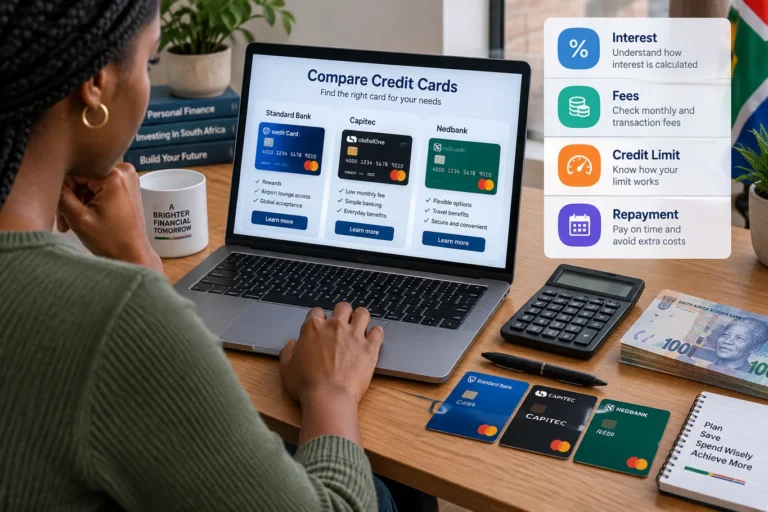
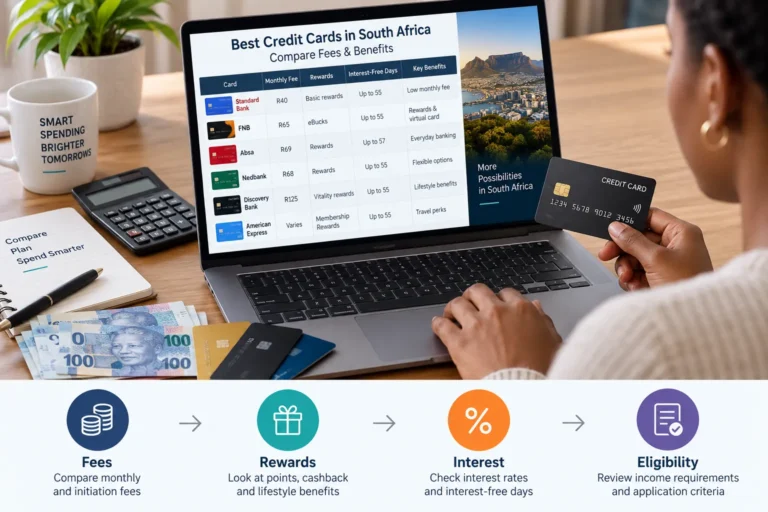
Compare the total cost
Do not choose a credit card solely because you meet its minimum income requirement.
Compare:
- Monthly fees
- Annual fees where applicable
- Interest rates
- Initiation or other charges
- Rewards
- Interest-free periods
- Credit limits
- Additional benefits
- Conditions attached to rewards
A card with attractive rewards may still be expensive if you regularly carry a balance.
Credit Card Requirements: Quick Checklist
Before applying, use this checklist:
Eligibility
- I am at least 18.
- I meet the provider’s residency requirements.
- I meet the specific card’s income requirement.
- My income can be verified.
- I can afford the repayments.
Documents
- South African ID or acceptable passport
- Recent payslip or other income proof
- Recent bank statements
- Proof of residence
- Additional documents if requested
Financial preparation
- I have checked my credit report.
- I know my existing monthly debt repayments.
- I have compared the card’s fees and interest.
- I understand the repayment requirements.
- I have not applied blindly for multiple cards.
Frequently Asked Questions
What documents do I need to apply for a credit card in South Africa?
Common documents include a valid ID or passport, proof of income, recent bank statements and proof of residence. The exact requirements vary by bank and credit-card product.
What salary do I need for a credit card?
There is no universal salary requirement. Some entry-level cards currently start around R5,000 per month, while premium cards can require substantially more. For example, Nedbank currently lists R5,000 per month for its Gold Credit Card and R25,000 per month for its Platinum Credit Card.
Can I get a credit card with a low income?
Possibly. Some credit cards have relatively low income thresholds, but approval also depends on affordability, creditworthiness and the provider’s other criteria.
Can I apply for a credit card without a payslip?
Possibly, depending on your circumstances and the provider. Self-employed or other applicants without conventional payslips may be asked for alternative evidence of income.
Does a credit score guarantee credit-card approval?
No. A credit score is only one part of the assessment. Providers may also consider income, expenses, existing debt, credit history and information supplied in the application.
How many months of bank statements do I need?
Three months is commonly requested. For example, Standard Bank and FNB currently list three months of bank statements for relevant credit-card applications.
What happens if my credit-card application is rejected?
Ask the provider for the reason for the rejection. Different providers use different assessment criteria, and a rejection does not necessarily mean that every credit provider will reject you.
Bottom Line
The basic credit card application requirements in South Africa usually involve identity verification, proof of income, recent bank statements, proof of residence and an affordability and credit assessment.
The most important point is that there is no single set of requirements for every credit card. Minimum income, acceptable documents, fees and eligibility criteria differ between banks and products.
Before applying, check the bank’s current product page, prepare your documents, review your credit information and make sure the repayments fit comfortably within your budget.
Credit should be treated as a financial tool rather than additional income. If you carry a balance from month to month, interest and fees can make purchases significantly more expensive.
This article is for general educational purposes and is not personalised financial advice. Product requirements, fees and eligibility criteria can change. Verify current information with the relevant credit provider before applying.

What do you think?
Ask a question, share your experience or add a helpful comment.