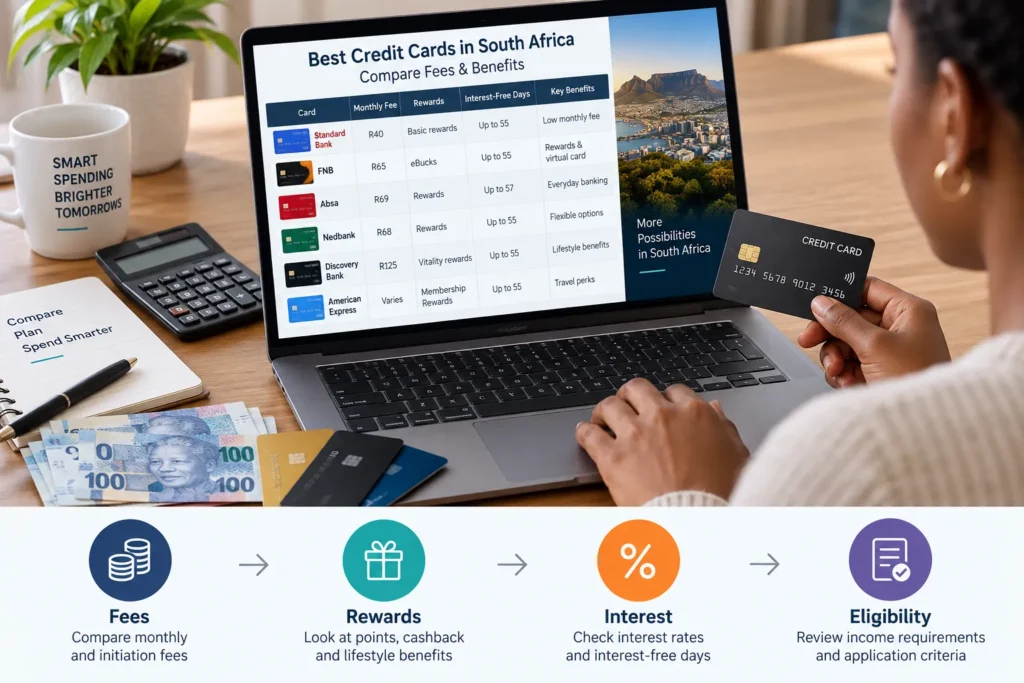
Finding the best credit card in South Africa is not simply about choosing the card with the most rewards.
A card that charges R40 a month but offers few rewards may be better for a light spender than a premium card costing several hundred rand a month. Conversely, frequent travellers may get considerably more value from a card with lounge access, travel insurance or airline rewards.
The right choice therefore depends on how much you spend, where you spend it, whether you travel and whether you repay the balance in full each month.
This guide compares several prominent South African credit-card options using current 2026 information published by the providers.
Best credit cards in South Africa at a glance

| Card | Monthly fee | Notable feature | Best suited to |
|---|---|---|---|
| Standard Bank Blue | R40 | Low monthly card fee | Everyday spending |
| FNB Aspire | R65 | eBucks and virtual card | Rewards-focused everyday users |
| Absa Gold | R69 total | Up to 57 interest-free days | General everyday use |
| Nedbank credit card | R68 | Up to 55 interest-free days | Lower-income qualifying applicants |
| Discovery Bank Gold | R125 | Vitality-linked rewards | Lifestyle/rewards users |
| American Express Gold | Provider pricing applies | Lounge and travel benefits | Travellers |
These are not identical products, so the lowest monthly fee does not automatically make one card better than another.
1. Standard Bank Blue Credit Card — best for low monthly cost
The Standard Bank Blue Credit Card is one of the more straightforward options for someone looking for a relatively low monthly card fee.
Standard Bank currently lists the Blue Credit Card at R40 per month, with a minimum monthly income of R5,000. The bank says the card has no annual fee, although an upfront initiation fee of R200 applies. Interest rates are personalised.
The card also provides access to Standard Bank’s digital and virtual-payment features.
Why consider it:
- R40 monthly fee
- Minimum monthly income of R5,000
- No annual fee
- Up to 55 days interest-free on qualifying spending when the outstanding balance is paid in full
- Virtual payment functionality
Best for: Someone who wants a relatively inexpensive credit card for ordinary purchases.
Watch out for: A low monthly fee does not mean borrowing is cheap. Interest can become expensive if you carry a balance.
2. FNB Aspire Credit Card — best for eBucks users
The FNB Aspire Credit Card is particularly interesting for consumers who actively use the FNB ecosystem and can make meaningful use of eBucks rewards.
FNB currently lists the Aspire Credit Card with a R65 monthly account fee, credit limits from R1,000 and an initiation fee of up to R210. The card also supports FNB virtual cards and eBucks rewards.
The virtual-card functionality can be useful for online shopping because customers can create, cancel or temporarily block a virtual card through the FNB app. FNB also says its virtual card supports several payment-wallet options.
Why consider it:
- R65 monthly fee
- eBucks earning potential
- Virtual-card functionality
- Credit limit from R1,000
- Useful integration with the FNB ecosystem
Best for: FNB customers who already understand and use eBucks.
Watch out for: Rewards depend on qualifying spend and programme rules. Do not spend more simply to earn rewards.
3. Absa Gold Credit Card — best for everyday banking
The Absa Gold Credit Card offers a relatively accessible combination of benefits and pricing.
Absa currently lists a R39 monthly account fee plus a R30 monthly credit-facility fee, making the total monthly fee R69. The listed minimum monthly income is R7,000. The card offers up to 57 days interest-free on purchases and has a minimum payment of 3% of the outstanding balance.
The card also includes basic international travel cover and Visa-related services.
Why consider it:
- R69 total monthly fee
- R7,000 minimum monthly income
- Up to 57 interest-free days
- International usage
- Basic travel-related benefits
Best for: Consumers wanting a conventional bank credit card with a moderate monthly cost.
Watch out for: The interest-free period does not mean all borrowing is interest-free. Paying only the minimum can result in interest accumulating on the outstanding balance.
4. Nedbank Credit Card — best for a lower-income qualifying applicant
Nedbank currently advertises a credit-card option with a R68 monthly service fee, a minimum income of R6,600 per month and up to 55 interest-free days. The interest rate is personalised.
Nedbank also publishes 2026 credit-card pricing guides covering its various card products and related fees. The bank states that its pricing guide fees are effective from 1 January to 31 December 2026.
Why consider it:
- R68 monthly service fee on the advertised card
- R6,600 minimum income
- Up to 55 interest-free days
- Personalised interest rate
- Virtual-card and app-management functionality
Best for: Consumers who meet the income requirement and want a mainstream bank credit card.
Watch out for: Nedbank has multiple credit-card products, so check the exact product and its pricing before applying.
5. Discovery Bank Gold Credit Card — best for lifestyle rewards
Discovery Bank takes a different approach to credit-card rewards.
Its Gold Credit Card Account currently has a R125 monthly fee, which includes the account fee, Vitality Money premium and single credit-facility fee.
The attraction is the potential value from Discovery’s broader rewards ecosystem. For example, Discovery says qualifying Gold customers can unlock enhanced rewards through Vitality Money and qualifying spend.
Why consider it:
- Integrated rewards ecosystem
- Vitality Money benefits
- Lifestyle-related rewards
- Digital banking experience
Best for: People who actively participate in the Discovery ecosystem and will actually use the available rewards.
Watch out for: The R125 fee is higher than several basic credit-card options. The card makes more sense when the rewards you actually use exceed the additional cost.
6. American Express Gold — best for frequent travellers
The American Express Gold Credit Card is a more specialised proposition.
Current American Express information for South Africa highlights 5,000 bonus Membership Rewards points after meeting the stated activation and spending requirements, one Membership Rewards point per R5 of eligible spending, automatic basic travel insurance of up to R4 million and up to 12 complimentary visits per year to Bidvest Premier Club domestic lounges.
American Express states that its cards are issued in South Africa under licence by Nedbank.
Why consider it:
- Travel-focused benefits
- Lounge access
- Membership Rewards
- Travel insurance
- Travel-service benefits
Best for: Consumers who travel regularly and can extract enough value from the travel benefits.
Watch out for: Rewards and travel benefits only have value if you actually use them. Also check merchant acceptance before relying exclusively on the card.
Credit-card fees: what should you compare?
The monthly fee is only one part of the cost.
When comparing credit cards, look at:
Monthly or annual card fee
This is the recurring amount you pay for having the card or credit facility.
For example, the currently advertised monthly charges vary from around R40 for Standard Bank Blue to R125 for Discovery Gold, while premium products can cost considerably more.
Interest rate
This can become the biggest cost if you carry a balance.
Credit-card interest rates are often personalised according to the applicant and product. Standard Bank, Nedbank and other providers explicitly indicate that rates can be personalised.
South Africa’s credit market is regulated under the National Credit Act. The applicable maximum interest rate and fee limitations depend on the type of credit agreement and prevailing regulatory rules.
Initiation fee
Some cards charge a once-off initiation fee when the credit agreement is opened.
For example, Standard Bank currently lists a R200 initiation fee for its Blue Credit Card, while FNB Aspire lists an initiation fee of up to R210.
Rewards
Rewards should be evaluated based on real spending, not advertised maximum rewards.
If you spend R10,000 a month but earn rewards worth only R50 after fees, a premium card may not be worthwhile.
How to choose the best credit card for your needs
If your priority is low fees
Start with basic cards such as Standard Bank Blue and compare the total cost against alternatives.
Don’t look only at the advertised monthly fee. Include initiation charges and other fees you are likely to incur.
If your priority is rewards
Compare the actual rand value of rewards you can realistically earn.
A rewards programme requiring complicated spending conditions may be less useful than a simpler programme that fits your normal shopping habits.
If you travel frequently
Look for:
- Airport lounge access
- Travel insurance
- Foreign transaction costs
- Airline or hotel rewards
- International acceptance
- Emergency card assistance
Visa, for example, provides benefits such as emergency card replacement and emergency cash assistance on eligible cards, while specific lounge benefits depend on the individual card and programme.
If you want to build or maintain a healthy credit profile
Use the card responsibly and avoid borrowing more than you can comfortably repay.
Getting approved for a card does not mean you should use the entire credit limit.
Why paying the full balance matters
One of the most important credit-card rules is simple:
If possible, pay the full statement balance by the due date.
Several cards advertise interest-free periods of around 55 days, while Absa advertises up to 57 days on qualifying purchases.
However, an interest-free period should not be interpreted as unlimited free borrowing.
If you carry debt beyond the applicable interest-free arrangement, interest can significantly reduce the value of rewards.
For example, earning R500 worth of rewards while paying substantially more than R500 in interest defeats the purpose of the rewards programme.
What income do you need for a South African credit card?
There is no single income requirement for every credit card.
Current examples illustrate the difference:
- Standard Bank Blue: minimum monthly income of R5,000.
- Nedbank advertised card: minimum monthly income of R6,600.
- Absa Gold: minimum monthly income of R7,000.
- Absa Premium: R25,000 monthly income.
But meeting an advertised income requirement does not guarantee approval.
The National Credit Regulator explains that credit providers must conduct affordability assessments and consider income, deductions, living expenses, existing debt obligations and repayment history.
South African interest rates and credit cards
Interest rates are an important consideration when comparing cards.
The SARB’s July 2026 Monetary Policy Committee statement recorded the SARB policy rate at 7%, with the next scheduled MPC decision on 23 September 2026.
This matters because South African lending rates can be linked to reference rates and can change over time.
Therefore, an article comparing credit cards should not present one interest rate as permanently fixed unless the provider explicitly guarantees that rate for the relevant product and period.
Are expensive credit cards worth it?
Sometimes—but only when the benefits exceed the cost.
Consider two hypothetical consumers.
Consumer A pays R40 per month for a basic card.
Annual card cost:
R40 × 12 = R480
Consumer B pays R125 per month for a rewards-focused card.
Annual cost:
R125 × 12 = R1,500
Consumer B needs to receive at least R1,020 more in genuine additional value than Consumer A to justify the extra annual fee.
That value could come from rewards, travel benefits, discounts or other benefits.
The important word is genuine.
A benefit advertised at R1,000 is not necessarily worth R1,000 to you.
Credit-card mistakes to avoid
1. Choosing a card because of the reward points alone
Calculate the fees and spending requirements first.
2. Carrying debt to earn rewards
This can turn a rewards card into an expensive form of borrowing.
3. Ignoring initiation fees
A once-off fee can affect the first-year cost considerably.
4. Assuming the maximum reward is guaranteed
Many rewards depend on qualifying transactions, spending levels, account status and programme rules.
5. Choosing a premium card you cannot justify
Airport lounges and lifestyle benefits are valuable only if you actually use them.
6. Using the entire credit limit
A credit limit is the maximum amount the provider allows you to borrow—not a spending target.
Frequently asked questions
What is the best credit card in South Africa?
There is no universally best credit card. Standard Bank Blue is attractive for lower monthly fees, FNB Aspire for eBucks users, Absa Gold for general everyday use, Discovery Gold for Vitality-oriented rewards and American Express Gold for certain frequent travellers.
Which credit card has the lowest monthly fee?
Among the products reviewed here, Standard Bank Blue currently lists a monthly fee of R40.
However, the lowest monthly fee does not necessarily mean the lowest overall cost.
How much salary do I need for a credit card?
Requirements vary by provider and product. Current examples range from R5,000 monthly income for Standard Bank Blue to R25,000 for Absa Premium.
Is a credit card good for building credit?
Responsible use can form part of a healthy credit history, but a credit card should not be taken solely to build credit if the borrower cannot comfortably manage the repayments.
Should I pay my credit card in full every month?
For consumers who can afford to do so, paying the full statement balance by the due date can help avoid interest on qualifying purchases under the applicable interest-free arrangement.
Are credit-card rewards worth it?
They can be, but only when the value of rewards and benefits exceeds the card’s fees and any additional costs.
Final verdict
The best credit card in South Africa depends on your spending behaviour.
For someone prioritising a low recurring cost, Standard Bank Blue is worth comparing. For an FNB customer who actively uses eBucks, FNB Aspire may provide stronger everyday value. Absa Gold offers a conventional combination of pricing and interest-free spending, while Nedbank’s advertised credit card has a relatively accessible income requirement.
Consumers heavily invested in the Discovery ecosystem may find Discovery Bank Gold more compelling because of its rewards structure. Frequent travellers should also investigate American Express Gold, particularly if lounge access and travel rewards are genuinely useful to them.
The most important rule is not to choose a card simply because it advertises the biggest reward.
Compare the total annual cost, rewards you can realistically earn, interest rate, eligibility requirements and benefits you will actually use.
And before applying, check the provider’s latest pricing guide and terms because fees, rewards and eligibility criteria can change.

What do you think?
Ask a question, share your experience or add a helpful comment.