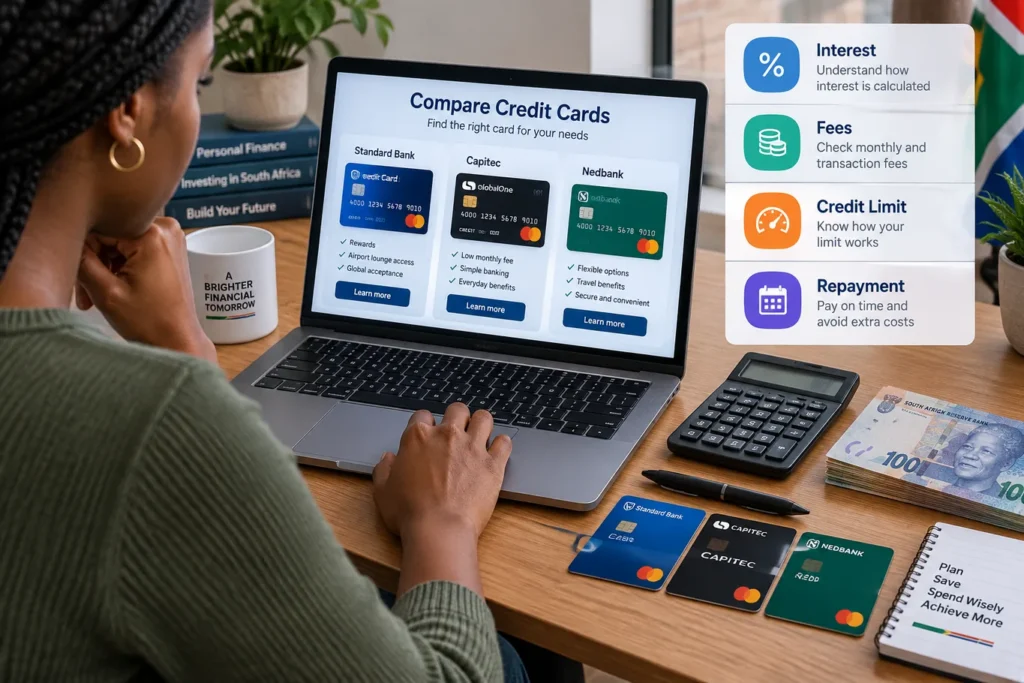
How Credit Cards Work . A credit card can make everyday spending more flexible, help you manage short-term cash flow and provide rewards or other benefits. But it is important to understand that a credit card is borrowed money, not extra income.
In South Africa, credit cards operate within the country’s consumer-credit framework, including the National Credit Act (NCA). The NCA regulates consumer credit and establishes rules around credit providers, credit costs, responsible lending and consumer protection.
The basic idea is simple: your bank gives you a credit limit, you use some of that limit to make purchases, and then you repay what you owe. The cost of borrowing depends on the card’s interest rate, fees and how you manage your repayments.
This guide explains how the process works, what interest-free days actually mean, which fees to look for and how to use a credit card responsibly.
Important: Credit-card rates, fees and eligibility requirements change. Examples below are based on current information available in 2026 and should be checked against the provider’s latest pricing guide before you apply.
What Is a Credit Card?
A credit card is a form of credit facility.
Instead of paying directly from money already sitting in your bank account, you use a credit facility provided by the bank. The amount you spend becomes part of your outstanding balance.
For example, suppose your credit limit is R20,000.
You spend:
- R2,000 on groceries
- R1,000 on fuel
- R500 on online purchases
Your total spending is R3,500.
You have approximately R16,500 of unused credit remaining, assuming there are no other transactions or charges.
The R3,500 is money you owe the credit provider.
Under the NCA, a credit facility is an arrangement where a credit provider allows a consumer to obtain goods, services or amounts of money and defer payment or be billed periodically.
How Credit Cards Work in South Africa
The process normally looks like this:
Application → credit assessment → credit limit → purchases → statement → repayment
1. You apply for a credit card
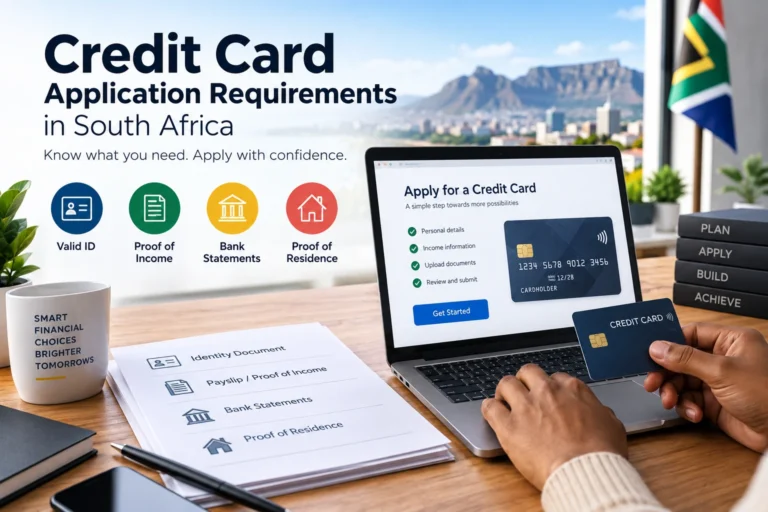
The bank asks for information such as your identity, income and financial circumstances.
Requirements differ between banks and individual cards.
For example, current Standard Bank and Nedbank product pages show different minimum-income requirements for different cards. Standard Bank’s Blue Credit Card currently lists a minimum income of R5,000 per month, while Nedbank’s New Gold Credit Card also lists R5,000 per month. Higher-tier cards can require substantially more income.
Meeting the advertised income requirement does not automatically mean you will be approved.
2. The provider assesses your application
The provider considers factors such as affordability and your credit profile.
A bank may therefore offer different credit limits and interest rates to different customers.
Nedbank, for example, states that credit facilities are subject to affordability and credit assessment and that interest rates are personalised.
3. You receive a credit limit
Your credit limit is the maximum amount of credit available to you under the facility.
If your limit is R15,000 and you have used R4,000, your remaining available credit is approximately R11,000, subject to pending transactions, fees and other adjustments.
You should not think of the full limit as money you can afford to spend.
4. You use the card
You can generally use a credit card for eligible purchases at participating merchants, online and, depending on the product, internationally.
Each purchase increases the amount you owe.
5. You receive a statement
Your monthly statement normally shows information such as:
- previous balance
- new transactions
- payments
- fees
- interest, where applicable
- outstanding balance
- minimum payment
- payment due date
- available credit
The statement is one of the most important documents to understand before using a credit card regularly.
6. You repay the balance
You can normally repay some or all of the outstanding balance.
The most important distinction is between paying the full amount required to avoid purchase interest under your card’s terms and paying only the minimum.
How Does Credit Card Interest Work?

Credit-card interest is the cost of borrowing money.
South African credit legislation regulates the costs that can be charged under credit agreements. Section 101 of the NCA identifies permitted costs including interest, service fees, initiation fees, credit insurance and certain default and collection costs.
The exact interest rate on your card depends on the product and your individual pricing.
Some banks explicitly state that their credit-card rates are personalised. Standard Bank, for example, says its credit-card interest rates are personalised and can range from a product-specific minimum to the maximum permitted under the NCA regulations.
What Does the Annual Interest Rate Mean?
If your card has an annual interest rate, that rate describes the annualised cost of borrowing.
It should not be interpreted as simply adding the annual percentage to every purchase once per year.
The provider’s agreement determines how interest is calculated and applied.
This is why comparing cards based only on the advertised monthly fee can be misleading. A card with a low monthly fee can still become expensive if you regularly carry a balance at a high interest rate.
What Are Interest-Free Days?
Many South African credit cards advertise an interest-free period on qualifying purchases.
For example, several current bank products advertise up to 55 interest-free days when the relevant conditions are met. Standard Bank’s Blue, Gold and other cards currently advertise up to 55 days, while Nedbank also advertises up to 55 days on several cards.
The important word is “up to.”
It does not necessarily mean every purchase automatically receives 55 days of free credit.
The actual number of days can depend on:
- when the purchase is made
- your statement cycle
- the payment due date
- whether the purchase qualifies
- whether you meet the provider’s repayment conditions
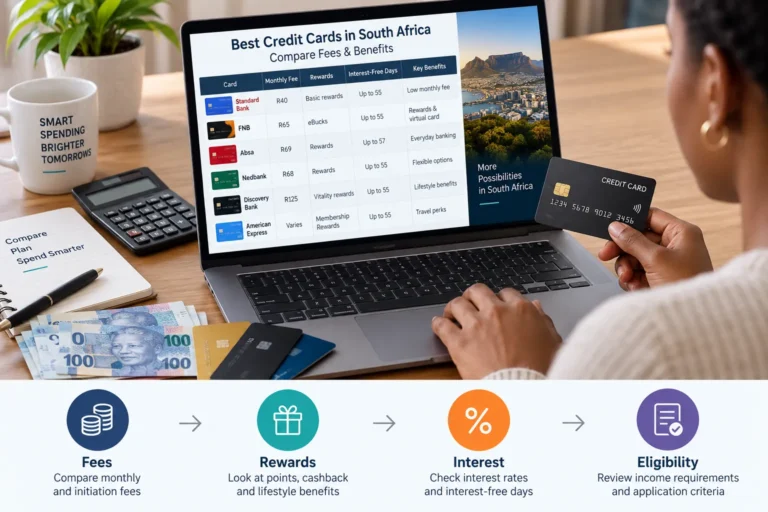
Read More Best Credit Cards in South Africa 2026: Fees & Benefits
Example
Imagine your statement period closes on the 30th.
You make a purchase near the beginning of the cycle. That purchase may have considerably more time before payment is due than a purchase made immediately before the statement closes.
Therefore, “55 interest-free days” should be understood as a maximum period under the card’s terms, not a guaranteed 55 days for every transaction.
Why Paying the Full Balance Matters
Suppose you spend R5,000 during a billing cycle.
If your card terms allow interest-free purchases when the balance is paid in full and you meet the required conditions, paying the relevant statement balance by the due date can prevent purchase interest from becoming a major cost.
By contrast, paying only the minimum can leave a balance outstanding.
That balance can then continue to attract interest according to your agreement.
This is one reason a credit card can become expensive even when the minimum monthly payment initially looks affordable.
What Fees Do Credit Cards Charge?
The cost of a credit card can include more than interest.
The NCA provides a framework for credit costs, while individual providers determine the fees applicable to their products within the applicable rules.
Common costs can include:
| Fee or cost | What it means |
|---|---|
| Monthly/card fee | Regular fee for the card or associated services |
| Service/facility fee | Charge associated with maintaining the credit facility |
| Initiation fee | Once-off fee when establishing certain credit agreements |
| Interest | Cost of carrying credit |
| Cash withdrawal cost | Charges associated with obtaining cash using credit |
| Foreign transaction costs | Costs that may apply to certain international transactions |
| Replacement fee | Possible cost of replacing a lost or damaged card |
| Credit insurance | Optional or applicable insurance depending on the product |
| Default-related charges | Charges that may arise if you fail to meet your obligations |
The exact amounts differ considerably.
For example, Standard Bank’s current Blue Credit Card page lists a R40 monthly fee and a R200 once-off initiation fee. Its Gold card currently lists a R64 monthly fee and R200 initiation fee.
Capitec’s 2026 fee information currently lists a R50 monthly administration fee for its credit card.
These figures are examples rather than a universal South African credit-card fee.
What Is the Minimum Credit Card Payment?
The minimum payment is the smallest amount the provider requires you to pay by the specified date under the card agreement.
It is not necessarily the amount you should aim to pay every month.
For example, Standard Bank currently states a minimum monthly repayment of 3% on certain credit-card products.
If you continually pay only the minimum, you can remain in debt for much longer than if you pay substantially more.
A simple illustration
Imagine you have a R10,000 outstanding balance.
There is a major difference between:
Option A: paying the applicable full balance each month.
Option B: repeatedly paying only the minimum amount.
Option B can leave a large balance outstanding, particularly when interest and fees are added.
The exact repayment period and total cost depend on your card’s interest rate, fees, payment behaviour and how new purchases are treated.
Credit Card Interest Rates and the SARB Policy Rate
South Africa’s interest-rate environment can influence borrowing costs.
As of the July 2026 Monetary Policy Committee meeting, the South African Reserve Bank policy rate was 7%.
The SARB has also been consulting on changes to the role of the prime lending rate. Historically, the prime lending rate has been maintained at 3.5 percentage points above the SARB policy rate.
However, consumers should not assume that their credit-card interest rate simply equals the SARB policy rate or prime rate.
Credit-card pricing can depend on the provider, product and individual risk profile.
Who Can Qualify for a Credit Card in South Africa?
There is no single income level that applies to every credit card.
Banks establish eligibility criteria for individual products.
Typical requirements can include:
- being at least 18
- living in South Africa
- valid identification
- proof of income
- affordability assessment
- satisfactory credit profile
- supporting documentation
For example, Nedbank currently says applicants for its New Gold card must be at least 18, live in South Africa, have a valid South African ID or qualifying passport/work permit and earn at least R5,000 per month.
Its Platinum card has a higher stated income requirement of R25,000 per month.
This illustrates why you should compare specific cards, rather than asking only whether you qualify for “a credit card.”
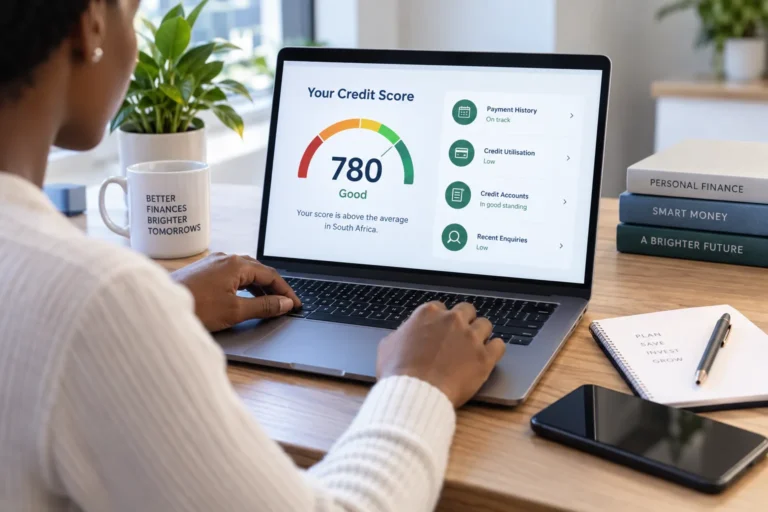
How Credit Cards Can Affect Your Credit Profile
Responsible credit-card use can form part of your broader credit history.
Important behaviours include:
- paying on time
- avoiding missed payments
- keeping borrowing manageable
- not repeatedly applying for unnecessary credit
- monitoring your credit accounts
- avoiding persistent over-indebtedness
A credit card should therefore be treated as a financial commitment rather than simply another payment method.
Credit Card vs Debit Card
| Feature | Credit card | Debit card |
|---|---|---|
| Money used | Borrowed credit | Money in your bank account |
| Interest | Can apply when credit is carried | Normally no borrowing interest |
| Credit facility | Yes | No |
| Credit history | Can affect credit profile | Generally not a borrowing account |
| Spending limit | Credit limit | Available account funds |
| Rewards | Often available | Depends on bank |
| Debt risk | Yes | Much lower from ordinary purchases |
Neither card is automatically better.
A debit card can be simpler if you want to spend only money you already have. A credit card can be useful if you understand the costs and repay responsibly.
Example: Using a R10,000 Credit Card Responsibly
Imagine you receive a credit card with a R10,000 limit.
You spend R2,500 during the month.
Your statement shows:
Credit limit: R10,000
Amount used: R2,500
Available credit: approximately R7,500
Statement balance: R2,500
If your card’s terms provide an interest-free period for qualifying purchases and you meet the repayment conditions, paying the applicable statement balance in full by the due date can help you avoid purchase interest.
The important lesson is that the R10,000 limit does not mean you have R10,000 of income.
Your actual obligation is the amount you borrowed.
10 Practical Tips for Using a Credit Card
1. Treat the credit limit as a ceiling, not a target
Having R30,000 available does not mean you should spend R30,000.
2. Know your statement date
The statement date and payment due date are important because they determine how your purchases and repayments are reported and handled.
3. Pay on time
Late payments can create additional costs and potentially damage your credit profile.
4. Pay more than the minimum when possible
If you cannot clear the balance, paying more than the minimum can reduce the amount of debt carried forward.
5. Understand the interest-free conditions
Do not assume every transaction automatically gets the maximum advertised interest-free period.
6. Compare total costs
Look beyond rewards.
Consider:
- monthly fees
- interest rate
- initiation fee
- cash withdrawal costs
- foreign transaction fees
- optional insurance
- rewards value
7. Be careful with cash withdrawals
Using a credit card to obtain cash can have different pricing and interest treatment from ordinary purchases.
Check the card’s terms before doing it.
8. Monitor your transactions
Review your statement regularly and report suspicious transactions promptly.
9. Don’t use one credit card to hide another debt
If you are repeatedly borrowing to pay existing debt, the problem may be affordability rather than the card itself.
10. Contact the provider early if you struggle to pay
Do not wait until the account has become severely overdue before asking what assistance may be available.
Frequently Asked Questions
How does a credit card work in South Africa?
A credit card gives you access to a credit facility up to an approved limit. You use the card to make purchases and then repay the amount owed according to your statement and credit agreement.
How many interest-free days do credit cards offer?
Some South African cards currently advertise up to 55 interest-free days on qualifying purchases, but the actual period depends on the transaction date, billing cycle and the card’s conditions.
Do I have to pay the entire credit-card balance?
You generally need to pay at least the required minimum payment by the due date, but paying the applicable balance in full can be much cheaper when your objective is to avoid purchase interest.
Is credit-card interest regulated in South Africa?
Yes. Credit costs, including interest and certain fees, fall within the regulatory framework of the National Credit Act and related regulations.
Does a credit card help your credit score?
Responsible use can contribute to your credit history, while missed or problematic repayments can have negative consequences. Your overall credit profile depends on information reported about your credit behaviour.
Can I use a South African credit card overseas?
Many cards can be used internationally, but foreign transactions can involve exchange-rate considerations and additional charges. Check the specific card’s pricing guide before travelling.
Is a credit card better than a debit card?
Not necessarily. A credit card offers access to borrowed money and may provide rewards or other benefits, while a debit card generally uses money already in your account. The better choice depends on how you manage money and credit.
Final Takeaway
A credit card is essentially a reusable credit facility.
You receive an approved limit, spend against that limit and repay what you owe. The important costs are not limited to the monthly fee: interest, initiation charges, transaction costs and other fees can all affect the real cost of the card.
The safest approach is straightforward:
Spend within your means, understand your statement, know the due date and pay the applicable balance in full whenever you can.
Before applying, compare the actual product pricing rather than choosing a card purely because it advertises rewards or a long interest-free period.

What do you think?
Ask a question, share your experience or add a helpful comment.
1 Comment
Leave a comment
good article,please post more