Financial disclaimer: This article is for general financial education and is not personalised financial advice. Credit scores, credit reports and lending criteria can vary between credit bureaus and credit providers. Always verify important information with the relevant provider or regulator before making financial decisions.
Improving your credit score in South Africa is less about finding a quick fix and more about building a reliable credit history over time.The most useful steps are straightforward: pay your accounts on time, reduce expensive or excessive debt, keep credit-card balances under control, avoid unnecessary credit applications, check your credit reports for errors, and deal with problems on your profile rather than ignoring them.
Your credit score is important, but it is only one part of a lender’s decision. Credit providers can use their own assessment models and may also consider factors such as your income, expenses, affordability and existing relationship with them.
This guide explains how to improve your credit profile responsibly and what South African consumers should know before paying anyone who promises to “fix” their credit.
What is a credit score?
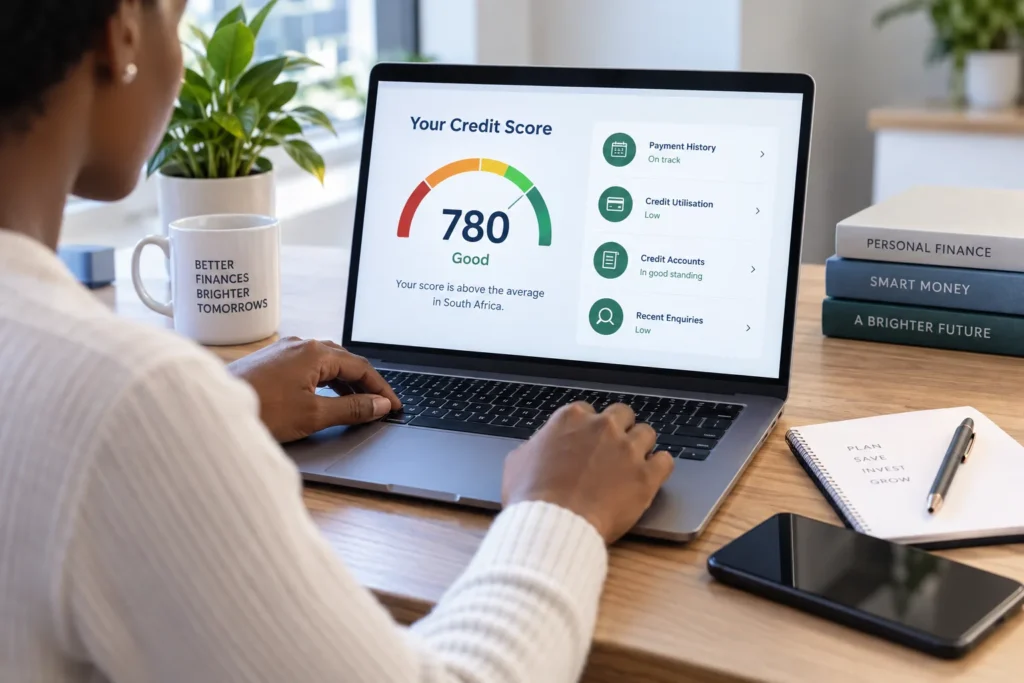
A credit score is a numerical indication of your credit behaviour based on information contained in your credit profile.
Different credit bureaus can use different scoring models, so there is not necessarily one universal score that every lender sees. For example, TransUnion’s consumer score ranges from 0 to 999, while lenders can use their own scoring and assessment criteria.
Your credit report can contain information about your credit accounts, payment behaviour, enquiries and other information relevant to your credit history.
A lender may then combine this information with other details when deciding whether to approve an application.
Why does your credit score matter?
A stronger credit profile can make you appear to be a more reliable borrower. However, a high credit score does not guarantee that a bank or other credit provider will approve an application.
TransUnion explains that credit providers have their own credit-granting policies and can consider affordability and other information in addition to a bureau score.
That means improving your score should not be viewed as a competition to reach a particular number. The bigger goal is to develop a healthy and sustainable credit profile.
7 practical ways to improve your credit score
1. Pay every credit account on time
Payment history is one of the most important areas to focus on.
Late payments can negatively affect your credit score, and TransUnion notes that a more serious late payment can have a greater effect than a shorter delay.
If you have several accounts, create a system that makes missed payments less likely.
For example:
- Set up debit orders where appropriate.
- Keep enough money available before debit-order dates.
- Add payment dates to your calendar.
- Check statements regularly.
- Pay at least the required amount by the due date.
- Contact the credit provider early if you know you may struggle to pay.
Paying on time consistently is generally more useful than trying to manipulate your score with short-term tactics.
2. Reduce high credit-card balances
The amount of available credit you are using can also matter.
TransUnion specifically identifies high account balances as a factor that can negatively affect its score. It recommends keeping credit-card balances below 35% of the available limit as a practical guideline, while noting that higher balances can be associated with score declines.
For example, suppose your credit-card limit is:
| Credit limit | 35% utilisation |
|---|---|
| R5,000 | R1,750 |
| R10,000 | R3,500 |
| R20,000 | R7,000 |
| R50,000 | R17,500 |
These figures are examples, not guaranteed scoring thresholds.
Read More Loans in South Africa: Compare Options, Rates & Requirements
If your card balance is consistently high, focus first on reducing the underlying debt. Do not borrow from another account simply to make one balance look smaller.
3. Avoid taking unnecessary new credit
Applying for several new accounts in a short period can make your credit profile look riskier.
TransUnion lists too many new accounts and credit applications within a short period among factors that can affect its score.
This does not mean you should never apply for credit.
Instead, ask yourself:
Do I actually need this credit, and can I comfortably afford the repayments?
If the answer is no, delaying the application may be better for both your finances and your credit profile.
4. Check your credit report for errors
One of the most overlooked ways to improve a credit profile is to make sure the information being reported about you is actually correct.
South African consumers have a right under the National Credit Act to inspect their credit-bureau information without charge once within a 12-month period.
Experian also currently provides consumers with access to free credit reports and scores through its Up platform.
When reviewing your report, look for:
- Accounts you do not recognise.
- Incorrect personal information.
- Payments incorrectly shown as late or unpaid.
- Accounts that should have been updated after payment.
- Credit applications you did not make.
- Incorrect balances.
- Information that belongs to another person.
If you find something inaccurate, do not pay a company simply because it promises to remove the listing.
Contact the relevant credit bureau and follow its dispute process.
TransUnion and Experian both provide dispute processes without charging consumers for legitimate disputes.
5. Dispute inaccurate information
A credit bureau cannot simply remove accurate negative information because you do not like it.
The important distinction is between incorrect information and accurate negative information.
For example, if a credit account does not belong to you, that is something you should challenge. If you genuinely missed payments on an account, however, paying a company to “erase” the history is not a legitimate shortcut.
TransUnion says inaccurate information can be investigated and corrected, while accurate negative information remains subject to the applicable legal retention rules.
Experian similarly allows consumers to dispute inaccurate information through its platform and says disputes are investigated within 20 business days.
Keep supporting documents such as:
- Proof of payment.
- Account statements.
- Letters from credit providers.
- Settlement or paid-up documentation.
- Identification documents where required.
- Relevant correspondence.
Good documentation makes it easier to explain what is wrong.
6. Deal with debt instead of ignoring it
A poor credit profile can sometimes be a symptom of a bigger problem: debt that has become difficult to manage.
If you are regularly using one credit account to pay another, skipping some accounts to pay others, or struggling to meet your monthly obligations, the priority should be your overall financial situation—not simply your score.
The National Credit Regulator describes debt counselling as a formal process intended to assist consumers who are over-indebted by assessing their financial position and restructuring debt obligations where appropriate.
Debt counselling is not a magic credit-score repair service. It is a regulated debt-relief mechanism with consequences that consumers should understand before entering the process.
If you are considering it, use a debt counsellor registered with the NCR and understand the terms before signing anything.
7. Keep your credit behaviour stable
Credit improvement usually requires consistency.
Once your accounts are under control, avoid creating new problems by repeatedly opening unnecessary accounts, accumulating large balances or missing payments.
A stable pattern of responsible borrowing and repayment gives future credit assessments more positive information to work with.
The exact effect on your score will depend on your individual profile and the scoring model being used.
How long does it take to improve a credit score?
There is no universal number of days or months in which every person’s credit score will improve.
Your score is based on information in your credit profile, and new information can change the assessment over time. TransUnion says its score is calculated using the latest information available in the credit report when the score is requested.
That means improvement is usually better understood as a process rather than a deadline.
A realistic approach
First few weeks
- Obtain your credit report.
- Identify errors.
- Bring overdue accounts under control where possible.
- Stop unnecessary credit applications.
Following months
- Continue paying accounts on time.
- Reduce outstanding balances.
- Avoid unnecessary new debt.
- Monitor your credit profile.
Longer term
- Maintain consistent repayment behaviour.
- Keep debt affordable.
- Correct inaccuracies when they occur.
- Avoid repeating the behaviour that caused previous problems.
The important point is that there is no legitimate shortcut that can guarantee a specific score increase.
What if you have a bad credit score?
A low score does not mean that your financial situation can never improve.
Start by identifying why the profile is weak.
For example:
| Possible problem | Practical response |
|---|---|
| Missed payments | Prioritise getting accounts up to date and create a reliable payment system |
| High balances | Build a repayment plan and reduce expensive revolving debt |
| Incorrect information | Dispute inaccurate entries with the relevant bureau |
| Too many recent applications | Stop unnecessary applications and concentrate on existing obligations |
| Debt is unaffordable | Seek appropriate debt or financial assistance rather than taking more credit |
| Unknown accounts | Investigate immediately for possible fraud or reporting errors |
Do not focus only on the number displayed by a credit-score service. Look at the underlying report.
Can paying off debt improve your credit score?
Paying debt is generally important for improving your financial position, but you should not expect an automatic or immediate jump to a particular credit-score number.
A credit profile contains historical information, and different scoring models assess information differently.
TransUnion also notes that paying certain negative public-record items does not immediately undo all of their impact on a score.
The sensible approach is to:
- Pay what you can afford.
- Bring overdue accounts up to date where possible.
- Obtain proof when an account has been settled.
- Make sure the credit provider updates its information.
- Check your credit report afterwards.
What you should not do to “fix” your credit score
Be cautious when someone promises to remove legitimate negative information for an upfront payment.
TransUnion specifically warns consumers about so-called credit-repair agents that claim they can remove valid listings.
Be especially cautious about claims such as:
- “We can remove any blacklisting.”
- “We guarantee a 700+ score.”
- “Your bad credit will disappear in 24 hours.”
- “Pay us and we will delete your defaults.”
- “We can guarantee your loan approval.”
A legitimate service cannot promise that every accurate negative entry will simply disappear.
If information is genuinely wrong, use the bureau’s dispute process.
How to check your credit report in South Africa
You can obtain your credit information from registered credit bureaus.
For example, Experian currently provides a free report and score through its Up platform.
TransUnion also provides a free annual credit report and allows consumers to dispute incorrect information through its consumer services.
When checking your report, don’t look only at the score.
Review the underlying information and ask:
- Are all the accounts mine?
- Are the balances correct?
- Are my payments reported accurately?
- Are my personal details correct?
- Are there applications I do not recognise?
- Are accounts that I settled showing the correct status?
That information can tell you much more about what needs to change.
What is a good credit score in South Africa?
There is no single “good score” that applies to every credit bureau or lender.
For example, TransUnion’s consumer score currently uses these bands:
| TransUnion score | TransUnion band |
|---|---|
| 0–615 | Poor |
| 616–729 | Fair |
| 730–821 | Good |
| 822–917 | Very Good |
| 918–999 | Excellent |
These bands apply specifically to the TransUnion Consumer Credit Score and should not be treated as a universal South African scoring system.
A lender may use another score or assessment model.
Therefore, improving the underlying financial behaviour that produces your credit profile is more useful than chasing a particular number.
Frequently asked questions
Does checking my own credit report lower my credit score?
Checking your own credit information is different from applying for new credit with a lender. The important issue is to distinguish consumer access to your report from credit applications and lender enquiries.
How can I improve my credit score quickly?
There is no guaranteed instant method. Start by checking your report, correcting inaccurate information, paying accounts on time, reducing excessive balances and avoiding unnecessary new credit applications.
Can a paid credit-repair company remove a valid default?
You should be cautious about anyone making this promise. Accurate negative information is not simply removable because a consumer pays a third party. TransUnion specifically warns about companies claiming they can remove valid listings.
Does paying off a loan automatically give you an excellent credit score?
No. Your score depends on the wider information in your credit profile and the scoring model being used.
What should I do if my credit report contains an account that is not mine?
Contact the relevant credit bureau and submit a dispute with supporting documentation. Both TransUnion and Experian provide processes for challenging inaccurate information.
Is debt counselling the same as repairing your credit score?
No. Debt counselling is a formal process intended to assist consumers who are over-indebted. It focuses on managing and restructuring debt rather than simply increasing a credit-score number.
The bottom line
The best way to improve your credit score in South Africa is to improve the financial behaviour behind the score.
Pay accounts on time. Keep debt manageable. Reduce high revolving balances. Avoid unnecessary applications. Check your credit report regularly. Dispute information that is genuinely incorrect. And get professional help if your debt has become unaffordable.
Do not chase promises of instant credit repair.
Your credit score is a useful indicator, but it is not your entire financial identity. Lenders can use their own assessment models and consider affordability and other information when deciding whether to grant credit.
The most valuable improvement is therefore not simply a higher number—it is a credit profile supported by sustainable financial habits.

What do you think?
Ask a question, share your experience or add a helpful comment.