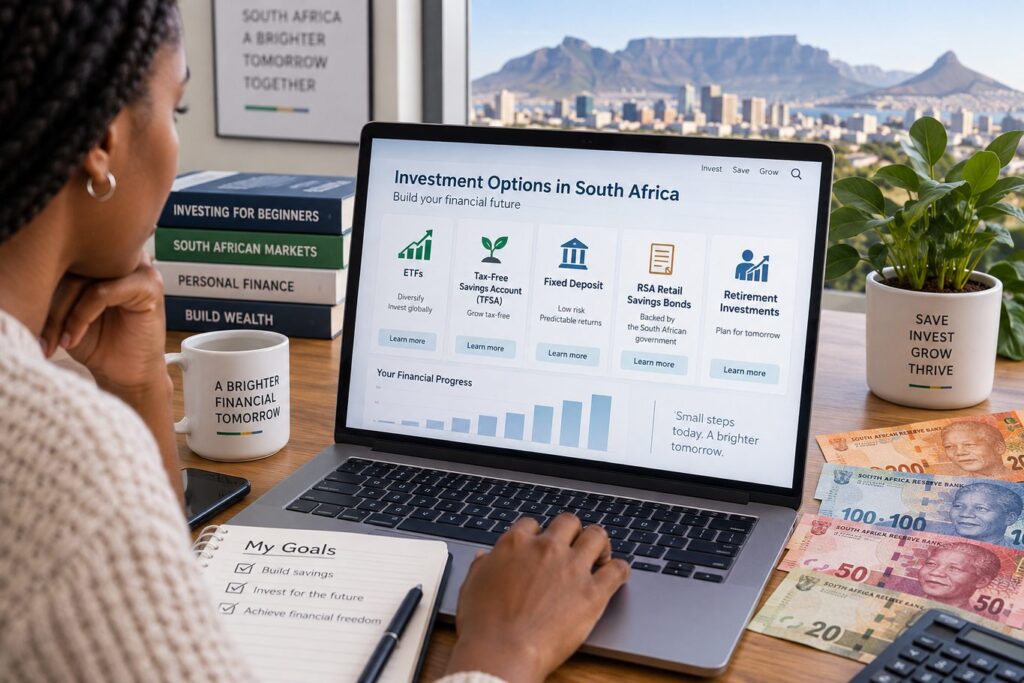
Finding where to invest in South Africa can be confusing, especially if you are investing for the first time. There are bank deposits, government bonds, exchange-traded funds, unit trusts, retirement products, shares, property investments and offshore options.
The right choice depends less on finding the investment with the highest advertised return and more on matching your money to your goal, time horizon, risk tolerance, liquidity needs and tax position.
For example, money you may need within a year generally should not be treated the same way as money you plan to invest for 20 years. A diversified investment portfolio can also look very different from an emergency fund.
This guide covers 10 investment options available to South Africans and explains what each is generally designed to do.
Important: This article is educational information, not personalised financial advice. Investment values can fall, past performance does not guarantee future returns, and tax treatment depends on individual circumstances. Check current product documents, fees and regulatory information before investing.
How to Choose Where to Invest
Before choosing an investment, answer five questions.
1. What is the goal?
Your objective might be building an emergency reserve, saving for a home deposit, preparing for retirement, generating income or building long-term wealth.
The investment should match the goal.
2. When will you need the money?
A short-term goal requires different characteristics from a retirement portfolio.
If you need the money soon, protecting capital and maintaining access can be more important than seeking higher long-term growth.
For long-term goals, investments with greater exposure to growth assets may be appropriate for some investors because there is more time to potentially recover from market declines.
3. How much risk can you accept?
Shares and equity ETFs can experience significant price movements. Cash and fixed-income investments can be less volatile, but they also have their own risks, including inflation and reinvestment risk.
There is no investment that is simultaneously guaranteed to provide high returns, zero risk and complete liquidity.
4. How quickly might you need access to the money?
Check withdrawal restrictions, notice periods, maturity dates and possible penalties before investing.
5. What are the tax implications?
The return you receive is not necessarily the return you keep after tax and costs.
South Africa has different tax treatment for interest, dividends, capital gains and qualifying tax-free investments. SARS currently provides an annual interest exemption of R23,800 for people under 65 and R34,500 for people aged 65 and older for the 2027 tax year.
10 Investment Options to Consider in South Africa
| Investment option | General risk | Typical purpose | Liquidity |
|---|---|---|---|
| Savings account | Low | Emergency/short-term savings | High |
| Fixed deposit | Low to moderate | Capital preservation/income | Low to moderate |
| RSA Retail Savings Bonds | Low to moderate | Medium/long-term fixed-income investing | Moderate |
| Money-market fund | Low to moderate | Cash management/short-term goals | Generally high |
| ETFs | Moderate to high | Long-term diversified growth | High |
| Unit trusts | Depends on fund | Diversification and managed investing | Usually moderate to high |
| Retirement annuity | Depends on underlying investments | Retirement planning | Low before retirement |
| JSE shares | High | Long-term growth/income | High |
| Property/REITs | Moderate to high | Property exposure/income/growth | Varies |
| Offshore/crypto | Varies from moderate to very high | Diversification/speculation | Varies |
Risk classifications above are broad educational descriptions. The actual risk depends on the specific product and underlying assets.
1. Savings Accounts
A savings account is one of the simplest places to keep money while earning interest.
It can be useful for an emergency fund or a short-term objective because the money is generally more accessible than money locked into a long-term investment.
However, a savings account should not automatically be considered a long-term wealth-building investment. If the interest earned does not keep pace with inflation and taxes, your money may lose purchasing power over time.
When comparing savings accounts, look beyond the advertised interest rate. Check:
- Monthly fees
- Minimum balance requirements
- Withdrawal restrictions
- Whether the quoted rate is variable
- How interest is calculated and paid
- Tax implications
2. Fixed Deposits
A fixed deposit allows you to place money with a financial institution for a specified period in exchange for an agreed interest rate, subject to the product’s terms.
Read More Best Investments in South Africa for Beginners 2026
This can be useful when you have a known amount of money and do not need immediate access to it.
The main attraction is predictability. You know the stated rate and maturity period when you enter the investment.
The trade-off is reduced flexibility. Early withdrawals may be restricted or subject to conditions.
For investors comparing fixed deposits, compare the effective return, term, early-withdrawal rules, fees and tax treatment, rather than choosing solely on the headline interest rate.
3. RSA Retail Savings Bonds
RSA Retail Savings Bonds are government-issued investments designed for individual investors.
They can be particularly relevant to conservative investors who want exposure to South African government debt rather than equity markets.
As of 1–30 September 2026, the official RSA Retail Savings Bond rates list:
- 2-year fixed-rate bond: 8.00%
- 3-year fixed-rate bond: 8.25%
- 5-year fixed-rate bond: 8.75%
- 3-year inflation-linked bond: 4.25%
- 5-year inflation-linked bond: 4.50%
- 10-year inflation-linked bond: 4.75%
These rates are published by the RSA Retail Savings Bonds programme and are date-specific, so investors should check the official rate page before investing.
The important point is that a government bond is not the same as a bank savings account or a share. It has its own maturity, interest-payment structure, inflation considerations and liquidity rules.
4. Money-Market Funds
Money-market funds invest in short-term interest-bearing instruments and are commonly used for cash management and relatively short-term investment objectives.
They can be an alternative to leaving excess cash entirely in a transactional account.
However, a money-market fund is an investment product rather than a normal bank deposit. The return is not the same thing as a guaranteed bank interest rate.
Before investing, check:
- Fund objective
- Underlying instruments
- Fees
- Current yield information
- Withdrawal arrangements
- Risk disclosures
Collective investment schemes are regulated within South Africa’s financial-services framework, and the FSCA provides information for investors and regulated entities.
5. Exchange-Traded Funds
Exchange-traded funds, or ETFs, are among the most accessible ways to gain diversified market exposure.
The JSE explains that ETFs track baskets of shares, bonds, commodities or other assets. They can be bought and sold similarly to listed shares.
Instead of buying one company’s share, an investor can use an ETF to gain exposure to a collection of underlying securities.
This diversification can reduce the concentration risk associated with owning a single company, although it does not eliminate the possibility of losses.
The JSE says investors can access ETFs through an authorised JSE equity member, an ETF provider’s investment plan or a financial-services platform.
Why beginners often consider ETFs
ETFs can offer:
- Diversification
- Access to different asset classes
- Simple portfolio construction
- The ability to invest regularly
- Exposure to domestic or international markets, depending on the fund
But investors should compare fees, tracking differences, underlying holdings and the risks of the particular ETF.
6. Unit Trusts
Unit trusts, generally referred to within the collective-investment-scheme framework, pool investors’ money into portfolios managed according to a stated investment mandate.
Different funds can have very different objectives.
One unit trust might focus on South African equities, while another may invest in bonds, income-producing assets or a combination of asset classes.
This means that saying “unit trusts are low risk” or “unit trusts are high risk” would be misleading.
The underlying portfolio determines much of the investment risk.
The FSCA regulates collective investment schemes and provides mechanisms for consumers to verify regulated financial-services providers.
Before selecting a fund, look at its:
- Investment mandate
- Historical performance
- Fees
- Risk profile
- Asset allocation
- Minimum investment
- Withdrawal rules
Past performance should be treated as historical information rather than a promise of future returns.
7. Retirement Annuities
A retirement annuity, or RA, is designed primarily for retirement saving.
Its major attraction can be its tax treatment. For the 2026/27 tax year, SARS states that qualifying contributions to pension, provident and retirement annuity funds can be deducted at 27.5% of the greater of remuneration or taxable income, subject to an annual cap of R430,000.
That does not mean every person should automatically maximise an RA contribution.
Retirement products have rules governing contributions, investments and access to retirement benefits. They should therefore be considered as part of a broader retirement strategy.
An RA may be more appropriate for money intended specifically for retirement than for money you may need in the next few years.
8. JSE Shares
Buying individual shares gives you direct exposure to listed companies.
If a company performs well, its share price may rise and it may pay dividends. But the opposite is also possible: share prices can fall substantially.
Individual shares therefore require more research and concentration-risk management than a diversified ETF.
Investors considering shares should understand:
- The company’s business model
- Revenue and earnings
- Debt
- Valuation
- Industry risks
- Dividend policy
- Competitive position
South African dividends received by individuals from South African companies are generally exempt from normal income tax, but a 20% dividends tax is generally withheld by the company paying the dividend.
That tax treatment is one reason investors should consider total after-tax returns rather than looking only at a company’s dividend yield.
9. Property and Listed Property Investments
Property is another popular investment category in South Africa.
Investors can gain property exposure by buying physical property or through listed property securities such as property-focused listed investments.
Direct property can generate rental income and potentially appreciate over time, but it also comes with costs and responsibilities.
These can include:
- Property maintenance
- Rates and taxes
- Insurance
- Vacancy risk
- Financing costs
- Legal and transaction costs
- Tenant-related risks
Listed property investments can provide a more accessible way to gain exposure to property without purchasing an entire building, although their market prices can fluctuate significantly.
Property therefore should not automatically be treated as a low-risk investment simply because it is a physical asset.
10. Offshore Investments and Crypto Assets
South African investors can also obtain exposure to investments outside the domestic market.
Offshore exposure can diversify a portfolio geographically and provide access to companies, sectors and economies that may not be represented adequately by the South African market.
However, offshore investing introduces additional considerations such as:
- Currency movements
- Foreign investment rules
- Tax treatment
- Platform and transaction costs
- Foreign-market risk
Crypto assets are a very different category.
The FSCA now regulates crypto-asset service providers under the relevant financial-services framework and publishes information about authorised CASPs.
That does not mean cryptocurrencies are low-risk investments.
Crypto prices can be extremely volatile, and investors can lose substantial amounts of money. Anyone considering a crypto platform should independently verify the provider’s current regulatory status rather than relying on advertising claims.
Where Should a Beginner Invest in South Africa?

There is no universal answer.
A sensible starting point is to separate your money according to when you expect to need it.
Money needed soon
Consider relatively liquid savings or suitable cash-management products.
The objective is usually accessibility and capital stability rather than maximising long-term growth.
Money needed in several years
You may have more flexibility to consider fixed-income products, diversified funds and other investments depending on your risk tolerance.
Money for retirement
Retirement-focused investments such as retirement annuities may be worth investigating because of their tax treatment and long-term structure.
Money for long-term wealth creation
Diversified equity investments, including suitable ETFs or unit trusts, may be considered by investors who can tolerate market volatility and have a long enough investment horizon.
The key is not to put every rand into one investment category.
TFSA vs Retirement Annuity vs ETF
These three are sometimes compared as if they were competing investments, but they serve different purposes.
| Feature | TFSA | Retirement annuity | ETF |
|---|---|---|---|
| What it is | Tax-advantaged investment account | Retirement investment structure | Investment fund/product |
| Main benefit | Tax-free qualifying growth | Retirement-focused tax benefits | Diversified market exposure |
| Annual contribution rule | R46,000 from 1 Mar 2026 | Deduction subject to rules | Depends on account/product |
| Lifetime TFSA limit | R500,000 | No equivalent TFSA lifetime limit | No TFSA limit unless held inside TFSA |
| Access | More flexible than retirement products, subject to account rules | Restricted by retirement legislation/rules | Depends on account used |
| Investment risk | Depends on underlying investment | Depends on underlying investment | Depends on underlying assets |
SARS confirms that qualifying TFSA returns are exempt from income tax, dividends tax and capital gains tax, with a R46,000 annual contribution limit and R500,000 lifetime limit from the 2026/27 tax year.
Importantly, a TFSA is an account structure, not necessarily one specific investment. Qualifying products can include fixed deposits, unit trusts and certain ETFs.
How Much Money Do You Need to Start Investing?
There is no single amount that applies to every investment.
Some platforms allow relatively small recurring contributions, while particular investment products may have their own minimums.
For a beginner, the more important question is often:
Can I invest consistently without compromising my emergency fund or essential expenses?
For example, someone who can invest R500 every month consistently may build a more useful long-term habit than someone who invests R10,000 once and then stops.
Before investing, consider paying down expensive debt and establishing an appropriate emergency reserve.
How to Check an Investment Provider
Before sending money to an investment provider, verify who you are dealing with.
The FSCA provides a search facility for authorised financial-services providers and regulated entities.
Check:
- Whether the provider is authorised where authorisation is required.
- What financial product you are actually buying.
- The total fees and charges.
- How and when you can withdraw your money.
- What happens if the investment falls in value.
- Whether the advertised return is guaranteed, projected or simply historical.
- Whether the provider has appropriate contact and regulatory information.
Be particularly cautious about investments promising unusually high returns with little or no risk.
A legitimate investment can still lose money.
Frequently Asked Questions
What is the best investment in South Africa for beginners?
There is no single best investment for everyone. A beginner should consider the goal, time horizon, risk tolerance, liquidity requirements, fees and tax position before choosing an investment.
Where can I invest R1,000 in South Africa?
Depending on the provider and product, R1,000 may be enough to begin investing through certain ETFs, unit trusts, savings products or investment platforms. Minimum contributions vary, so check the specific provider’s current requirements.
Is a TFSA an investment?
A TFSA is better understood as a tax-advantaged investment account or structure. The underlying product inside the account determines how the money is invested. SARS lists qualifying products including certain fixed deposits, unit trusts and ETFs.
Are ETFs safe?
ETFs are regulated listed investment products, but they are not risk-free. Their prices can rise and fall according to the underlying assets. Diversification can reduce concentration risk but cannot eliminate market losses.
Are RSA Retail Savings Bonds a good investment?
They can be relevant for investors seeking exposure to South African government debt and predictable interest structures. Whether they are suitable depends on your goals, term, tax position and need for liquidity.
Should I invest in property or shares?
Neither is automatically better. Shares can provide liquid exposure to businesses, while property can provide rental and property-market exposure. Both carry risks and costs.
Should South Africans invest offshore?
Offshore investments can provide geographic diversification, but they introduce currency, tax, regulatory and market considerations. They should be evaluated as part of the investor’s overall portfolio rather than simply because foreign markets have performed well historically.
Is cryptocurrency a good investment?
Crypto assets are highly volatile and speculative. The existence of authorised crypto-asset service providers does not remove the underlying investment risk. Investors should verify providers through the FSCA and understand that substantial losses are possible.
Final Thoughts
The question “Where to invest in South Africa?” does not have one correct answer.
For one person, a savings account may be appropriate because the money is needed soon. Another investor may prioritise an ETF for long-term growth. Someone preparing for retirement may focus on retirement products, while a conservative investor may prefer fixed-income investments such as RSA Retail Savings Bonds.
The strongest approach is to start with the purpose of the money and work backwards.
Consider time horizon, risk, liquidity, diversification, fees and taxes before choosing the investment.
Also remember that current rates, tax rules and investment products can change. For example, the RSA Retail Savings Bond rates quoted in this article apply specifically to September 2026, while SARS’s TFSA and retirement rules reflect the 2026/27 tax year. Always verify the latest information with the relevant regulator or provider before making a financial decision.

What do you think?
Ask a question, share your experience or add a helpful comment.